
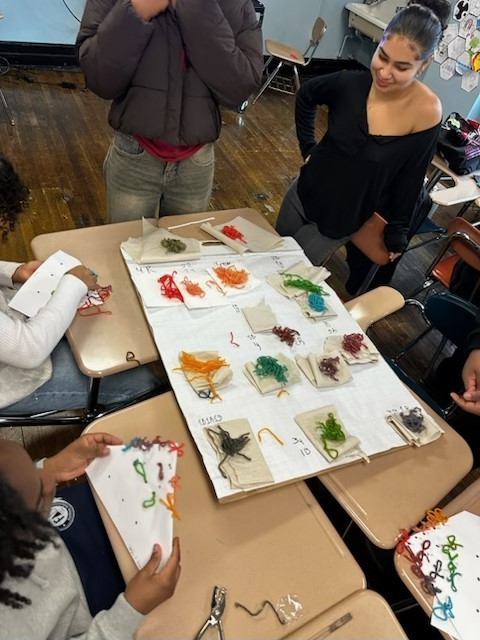
In our Textile Science class, students gain a comprehensive understanding of fibrous materials, moving from raw materials to finished products, and how their properties relate to performance and end-use. The core curriculum is interdisciplinary, drawing heavily on chemistry, physics, and engineering principles.
Students begin with the building blocks of textiles: fibers. They learn to classify and differentiate between them based on their chemical structure, physical characteristics, and sourcing. Next, students explore the chemical treatments applied to textiles to achieve desired aesthetics and functionality.
Dyeing and Printing: Principles of color theory, the chemistry of different dye classes, how dyes bond to various fibers, and common methods for adding color and patterns to fabric.
Chemical Finishes: Studying treatments that enhance performance, such as water-repellency (DWR), wrinkle-resistance, flame-retardancy, and antimicrobial finishes.
Mechanical Finishes: Processes like sanding, brushing, or calendering to alter the texture and appearance of the fabric.
In their most recent experiments, our students created a triangle of color using different ratios of food coloring, exploring how primary colors blend to make various shades.
This hands-on experiment helped them understand how changing dye ratios transforms color—skills they’ll use to create their own custom-dyed yarn!
Next, they’ll bring those colors to life in Textile Fashion class as part of an exciting collaborative weaving project.
Stay tuned for their final piece! #textilescience #fashionsciencecollaboration